

How a Unified Software Delivery Platform Changes the Way Teams Build
Engineering teams have always faced the same fundamental challenge: too many tools, too little visibility, and delivery timelines that feel more like educated guesses than reliable commitments. As software development grows more complex, the gap between what teams intend to ship and what actually reaches production continues to widen. A well-architected software delivery platform closes that gap by bringing orchestration, talent, infrastructure, and AI agents under a single control plane—so every signal becomes a decision, not a mystery.
Why Fragmented Tooling Slows Engineering Teams Down
Most engineering organizations don’t suffer from a lack of tools. They suffer from too many of them. Project management sits in one system, code review in another, deployment pipelines somewhere else entirely, and incident response in a completely separate workflow. Each tool captures its own slice of reality, but none of them talk to each other fluently.
The result? Engineering leaders spend significant time manually reconciling data from disconnected systems rather than acting on it. Delivery bottlenecks go undetected until they become blockers. Sprint planning relies on intuition rather than evidence. And when something breaks in production, the time spent tracing the issue across multiple dashboards compounds the damage.
Unifying these tools into a single orchestration layer fundamentally changes the dynamic. When commits, pull requests, deployments, and incidents all flow through one normalized data layer, teams stop guessing and start governing.
What Modern Software Delivery Orchestration Actually Looks Like
Orchestration is more than integration. It’s the ability to act on connected signals automatically, within guardrails that preserve quality and security. Scrums.com is built around this principle, connecting tools like GitHub, Jira, Azure DevOps, ClickUp, and Slack while automating workflows across build, deploy, observe, and governance primitives.
AI agents handle code reviews with customizable quality gates, generate and execute tests, forecast sprint velocity, and flag delivery risks before they surface in standups. These agents don’t operate in isolation—they work within governed workflows, which means speed and compliance coexist rather than compete.
For engineering managers, this translates to higher-quality output without increased management overhead. For CTOs, it means real-time SDLC visibility across every team and tool. For founders scaling fast, it means launching with elite talent and automated workflows without the burden of full-time hiring cycles.
The Role of DORA Metrics in Measuring Delivery Health
Delivery speed matters. So does delivery reliability. DORA metrics—Deployment Frequency, Lead Time for Changes, Mean Time to Recovery, and Change Failure Rate—are the four indicators with a validated link to business outcomes, and they only become actionable when measured automatically.
Manual DORA tracking is labor-intensive and prone to gaps. Automated DORA measurement, pulled directly from git activity, CI/CD pipelines, and incident tools, gives engineering leaders a live rollup of team health without the spreadsheet overhead. It also creates the kind of audit trails that compliance frameworks like SOC 2 Type II, ISO27001, and HIPAA require—built in, not bolted on.
Scaling Talent Without Scaling Complexity
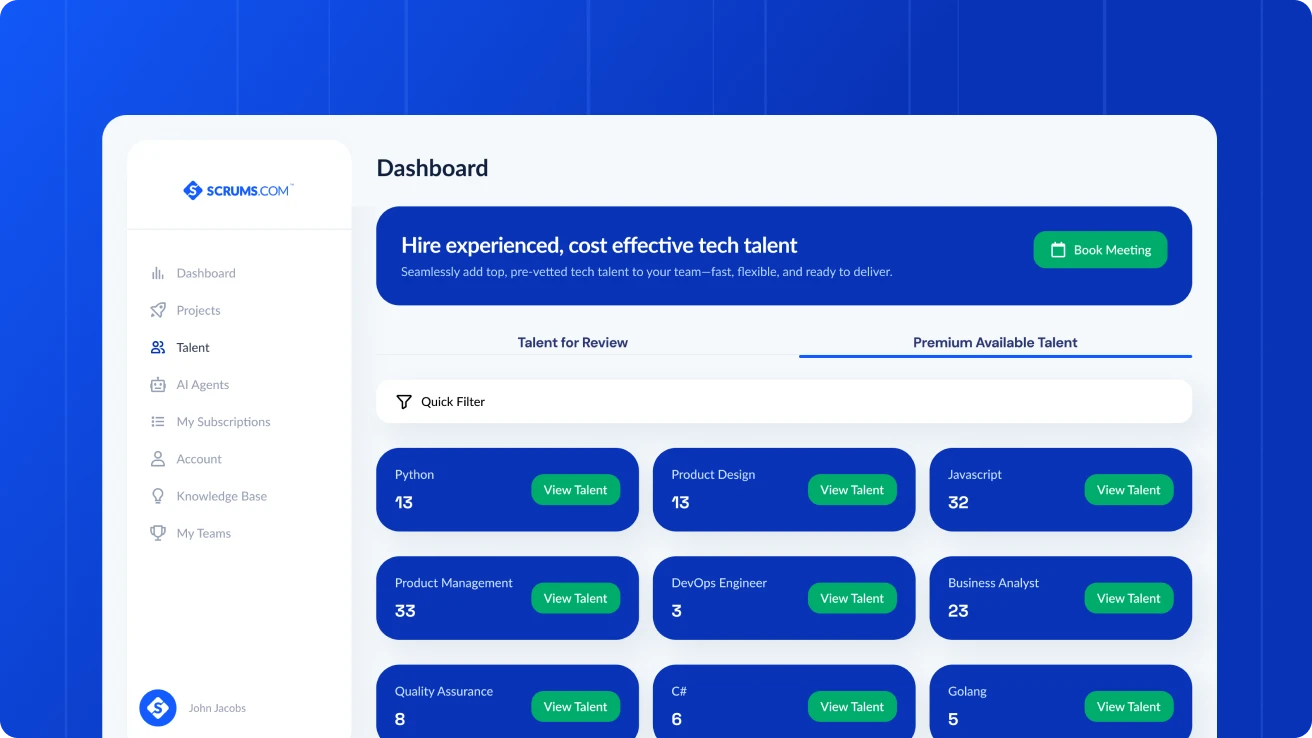
Delivery platforms aren’t just about tools and automation. Engineering capacity is a delivery variable too. Scrums.com integrates a network of AI-vetted engineers directly into the orchestration layer, with deployment timelines designed for speed and performance tracking built into the same dashboards teams already use.
This model separates team scaling from organizational complexity. Engineering managers don’t manage vendors separately—they monitor performance through the same control plane governing their pipelines, agents, and quality gates.
Building Software That Stays Ahead
The organizations that consistently ship great software aren’t necessarily the ones with the largest teams or the most funding. They’re the ones with the clearest visibility into their delivery system, the tightest feedback loops between signals and decisions, and the infrastructure to act quickly without sacrificing quality.
A unified software delivery platform makes that kind of clarity operational—not aspirational. Explore the Scrums.com platform and see how engineering orchestration works in practice.